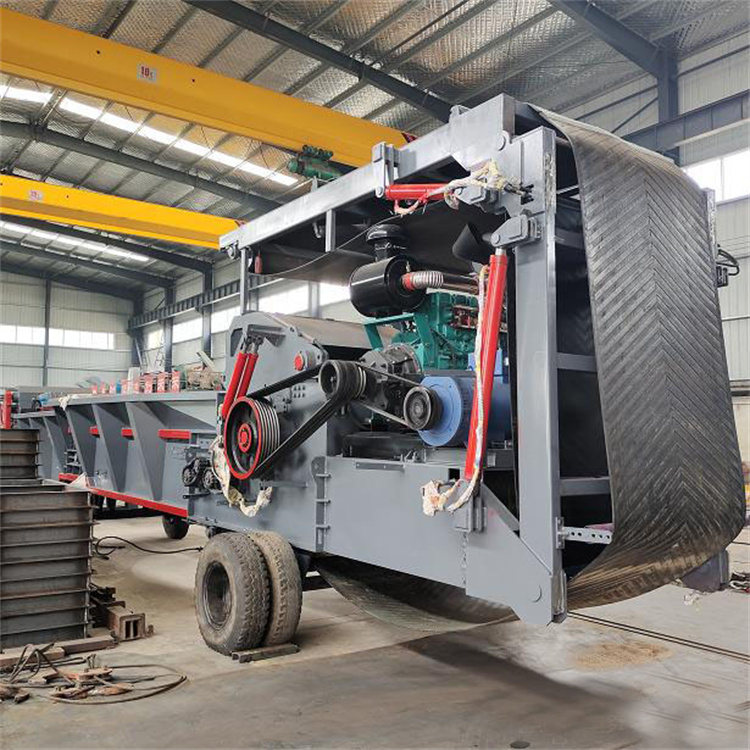
Walk into any equipment yard or scroll through an industrial machinery catalog, and you will quickly encounter two names that sound almost interchangeable: wood chipper and wood crusher. Both reduce wood waste. Both save on disposal costs. Both can turn a pile of branches into something useful. Yet they are built around fundamentally different principles, produce distinctly different outputs, and are not interchangeable in most professional operations. Choosing the wrong one means jammed feed chutes, worn cutting parts, or an end product that no buyer wants.
This guide breaks down the real differences between a wood chipper and a wood crusher, explains how each machine handles material, and provides a practical framework for matching the machine to your feedstock and your end product.
The Core Difference: Cutting vs. Impact
The distinction begins with how each machine applies force to wood.
A wood chipper uses sharp knives mounted on a rotating disc or drum. The knives slice through wood with a clean, shearing action, cutting branches and logs into relatively uniform chips. The machine is designed to grab whole pieces of wood—branches, limbs, small logs—and pull them through the cutting mechanism. Because the cutting action is clean and controlled, chippers are more productive and require less energy than grinding or crushing for machinery up to roughly 300 kW.
A wood crusher, by contrast, relies on a combination of impact, cutting, and screening. The material is first struck by rotating hammers or blades, then forced through a screen that determines the final particle size. This makes the crusher a refinement machine: it is designed to take material that is already relatively small—wood chips, offcuts, small scraps—and reduce it further into fine particles, sawdust, or a consistent biomass feedstock.
Put simply: a chipper handles whole wood; a crusher handles chips and small wood scrap. Feeding whole logs into a crusher will likely jam it or wear out the cutting parts quickly. Feeding chips into a chipper will not produce the fine, uniform output that most downstream processes require.
What the Output Looks Like
The practical consequences of this mechanical difference show up most clearly in the finished product.
Chipper output consists of wood chips with a controlled and relatively uniform size. Disc and drum chippers can produce chips of varying dimensions, but chippers generally struggle to produce chips longer than about 70 mm, and the output is typically in the range of 5 mm to 35 mm depending on blade, screen, and rotor setup. These chips have smooth cuts and consistent thickness—qualities that make them suitable for pulp mills, paper production, landscaping mulch, and biomass fuel.
Crusher output is finer and more variable in shape, but it is also more controllable through screen selection. Because the crusher uses a screen to size particles, the final product can be adjusted from coarse flakes down to fine sawdust, depending on the screen installed. This makes the crusher the machine of choice when the goal is a refined material: fine sawdust for pellet production, consistent biomass fuel, animal bedding, or a specific mulch texture.
If your business sells wood chips by the truckload, a chipper produces the product. If your business needs a feedstock that will pass through a pellet mill die or a boiler feed system without causing blockages, a crusher produces the specification.
Matching the Machine to Your Feedstock
The material you process is the single most reliable guide to the machine you need. The practical boundary is clearest when you look at the shape, cleanliness, and consistency of your feedstock.
Choose a wood chipper when your feed is clean, aligned, and whole. Drum chippers are the standard choice for clean slabs, edgings, branches, and other wood that can be fed in a continuous, aligned manner. Forestry operations, tree service companies, and sawmills processing clean logs and branches rely on chippers because the knife-cutting action delivers controlled chips at high productivity. Drum chippers are ideal for producing engineered chips from clean wood.
Choose a wood crusher when your feed is irregular, short, bulky, or difficult to present to a knife. Industrial biomass crushers are the better route for pallets, bark-rich residues, short offcuts, irregular blocks, and mixed wood waste. A crusher tolerates contamination—sand, grit, small stones, and tramp metal—far better than a chipper, because its blunt or hammer-based action is less sensitive to dulling than precision chipper knives. If your material arrives in inconsistent shapes and sizes, forcing it through a chipper often causes unstable feeding and excessive wear.
A useful rule of thumb: if you can pick up a piece of feedstock and align it reasonably well with the feed opening, a chipper can probably handle it. If the material is a jumble of short, irregular, or contaminated pieces that cannot be presented consistently, a crusher is the safer and more productive choice.
When You Need Both
In many professional operations, the answer is not either/or. A chipper and a crusher perform complementary roles in a two-stage size-reduction line.
The chipper performs the primary reduction: whole logs, branches, and slabs become manageable chips. The crusher performs the refinement: those chips are milled down to a consistent particle size suitable for pelletizing, briquetting, or a specific industrial specification. Trying to skip the refinement step often produces a product that does not meet downstream requirements and cannot command a premium price.
Sawmills, pallet recyclers, and biomass pellet plants frequently run this combination. The chipper handles the clean, long material; the crusher handles the short, irregular, and contaminated fraction. Material that would otherwise reduce capacity or accelerate wear in a single machine is routed to the machine best suited to handle it.
Throughput, Power, and Maintenance Realities
Beyond the mechanics, several operational differences influence the long-term cost of ownership.
Productivity and energy. For clean woody material, chippers are generally more productive and require less energy per unit of output than crushers or grinders, particularly at power levels below 300 kW. Feed rates for whole-tree chippers can be substantially higher than for grinders processing comparable material. However, chipping productivity drops when the material is small, irregular, or contaminated—precisely the conditions where a crusher maintains steadier throughput.
Maintenance profile. Chippers depend on sharp knives. Dull knives increase fuel consumption, reduce chip quality, and raise the risk of jams. Knife changes are a routine and predictable maintenance cost. Crushers use hammers and screens. They require less knife sharpening and tolerate contaminants better, but hammers wear over time and screens can blind or plug if the material is wet or fibrous.
Moisture sensitivity. Chippers generally handle relatively dry, clean wood best. Wet or green material can bridge in the feed chute and produce stringy chips. Crushers can handle higher moisture content more gracefully, though very wet material can still cause screen blinding. Matching the machine’s moisture tolerance to your actual feedstock conditions prevents chronic clogging.
A Practical Decision Framework
Use the following checklist to narrow the choice before reviewing specifications or requesting quotes.
1. Define the end product first. If the goal is uniform chips for landscaping, pulp, or fuel, a chipper is the natural starting point. If the goal is fine sawdust, a consistent biomass feedstock for pelletizing, or animal bedding, a crusher is required.
2. Characterize the feedstock. Clean logs, branches, and slabs point toward a chipper. Pallets, offcuts, bark, irregular blocks, and mixed waste point toward a crusher.
3. Assess contamination risk. If sand, grit, or metal is likely to be present, a crusher’s blunt-action design is more forgiving than precision chipper knives.
4. Consider the two-stage option. If the operation produces both clean whole wood and irregular scrap, a chipper plus crusher line usually delivers better overall productivity and lower wear than forcing everything through one machine.
5. Match capacity to real volume, not marketing peaks. Compare throughput ratings to your busiest normal week, not the ideal conditions in a brochure. Under-sizing a machine to save on capital cost almost always produces higher operating costs through downtime and maintenance.
Working with a manufacturer that offers both machine categories—and the application knowledge to match them—simplifies this decision. Henan Manto Machinery Equipment Co., Ltd. supplies wood chippers, wood crushers, and integrated size-reduction lines, with a selection guide that maps equipment types to raw materials and output requirements. Their range includes drum chippers for primary chip production and wood crushers for fine grinding and biomass feedstock preparation.
The Bottom Line
A wood chipper and a wood crusher are not competitors for the same job. They are sequential tools in a size-reduction chain, each optimized for a different feedstock condition and a different output specification.
Choose a chipper when you need to convert clean, whole wood into uniform chips—quickly and with relatively low energy input. Choose a crusher when you need to refine chips, scrap, and irregular waste into a fine, consistent material for pelletizing, bedding, or specialized industrial use. And when your operation handles both clean wood and irregular residue, run both machines in sequence rather than compromising on a single unit.
For operations that need a clear starting point, Henan Manto Machinery publishes detailed comparisons of grinder, crusher, and chipper performance, and their team can recommend a configuration based on feedstock samples and target output. The right machine is the one that matches the material in front of you—not the one with the most attractive headline specification.